


- EDITIONS:
 Spanish News Today
 Alicante Today
 Andalucia Today
Bajo de la Campana, the important Phoenician boat excavation at La Manga
Excavations at the Bajo de la Campana, Phoenician boat site in La Manga del Mar Menor
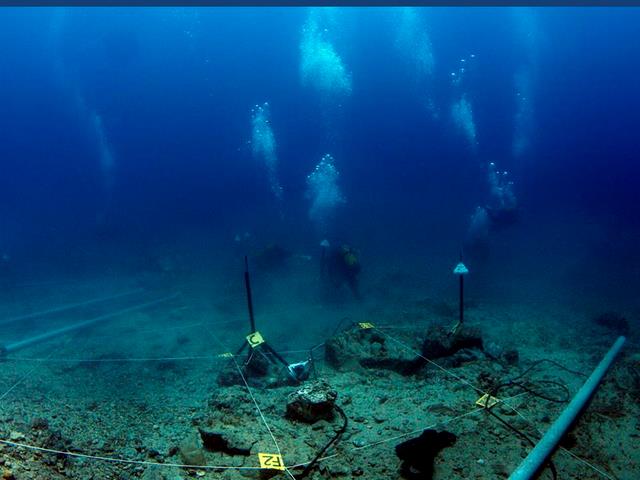
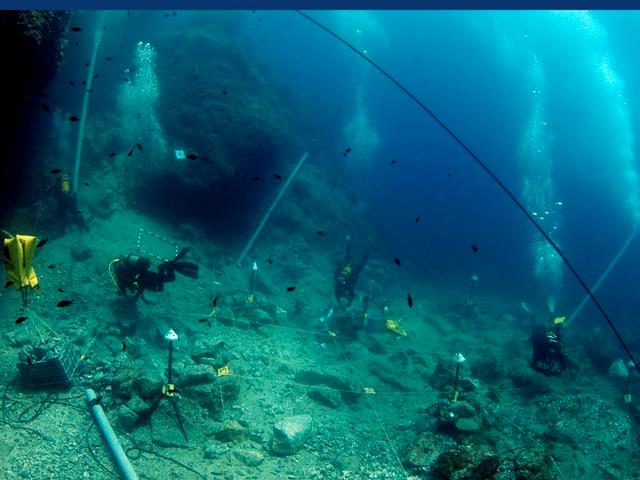
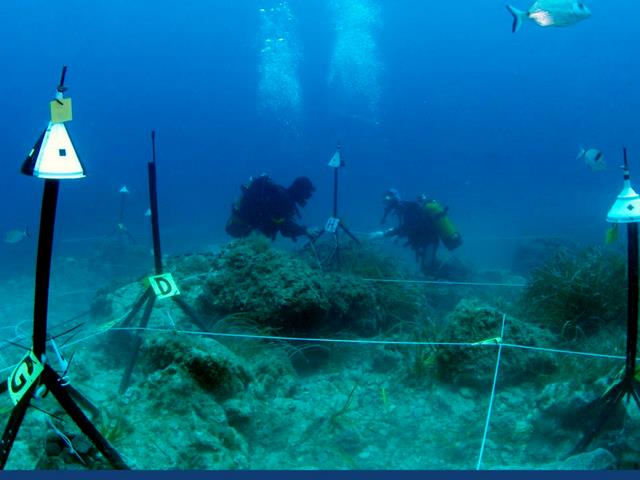 The Bajo de la Campana is one of the most important marine archaeological sites in the Region of Murcia, lying just a short distance from the shores of the La Manga strip.
It is home to the remains of not just one vessel, but four, among them a Phoenician ship which is believed to exceed 20 metres in length, the largest ever found on the Murcia coastline.
Overview
 The Bajo de la Campana marine archaeological site is located in the municipality of San Javier, close to Isla Grosa and La Manga del Mar Menor.
It is the location of the third Phoenician wreck to have been discovered in the Region of Murcia; there are two others at the Playa de la Isla in Mazarrón, smaller vessels measuring around 8 metres in length, which transported small quantities of goods along the coastline.
This wreck, dating from the 7th century before Christ, appeared to be carrying a large quantity of raw materials together with interesting trade goods, yielding valuable archaeological evidence about the trading activities of the Phoenician trading merchants.
A little history: who were the Phoenicians?
 The Phoenicians were an ancient civilization originally based in the Middle East, whose culture was at its most powerful between 1200 and 800 BC. They were great traders, active along the Mediterranean and Red Sea routes, and were known to have used an alphabet which was later adopted by the Greeks, with whom they were active trade partners.
Their society operated very much in the form of city states; their main bases were in what was then Phoenicia, being the cities of Byblos, Tyre, Sidon, Simyra, Arwad and Berytus, and from there they extended their trading activities across Europe and North Africa.
They traded a wide variety of goods including slaves, wood, glass, raw materials and luxury goods such as the colourful textiles produced using murex sea shells, the treasured Tyrian Purple dyed fabrics.
They were also accomplished metalworkers, and moved vast quantities of raw materials for smelting, trading silver and lead from Iberia (now Spain), copper from Cyprus and even tin from the Cornish mines of the UK, smelting the copper and tin to make bronze, the metal which revolutionized the world of weaponry.
They were active around the western Mediterranean as Phoenicia grew to its greatest around 1200 BC, when the balance of power in ancient society changed. This may have been due to a volcanic eruption provoking great movement of populations, and cultures known as "sea people" appeared in historical records in the Mediterranean basin and on the African coast. Their arrival provoked wars with Egypt, which, allied with a succession of crop failures, possibly caused by climate change, weakening Egyptian power and creating a vacuum which was filled by the Phoenicians.
However, by the 6th century BC their power was on the wane and Phoenicia was invaded by the Persians, so many fled to the trading colonies they had established throughout the Mediterranean: the most famous of these being Carthage on the north African coast.
 From here, they controlled their vast trading networks, focusing on minerals, with Spain and the area of modern day Cartagena an important source of supply.
But Rome was in the ascent, and a series of bitter and violently fought wars, the Punic wars, drove them ever further south until in 146 BC Carthage was sacked and the Phoenicians as a nation ceased to exist.
But the city of New Carthage, in southern Spain, survived, and is now known as Cartagena. Even today, geneticists report that one in 17 people along the South European and North African coasts today could be genetically descended from the Phoenicians, a testament to the extent of their influence and the establishment of their colonies and trading posts across the Mediterranean and Africa.
The Location of the Bajo de la Campana site
 The Bajo de la Campana wreck was discovered in the 1950s when divers looking for salvage and artefacts in the area found the site.
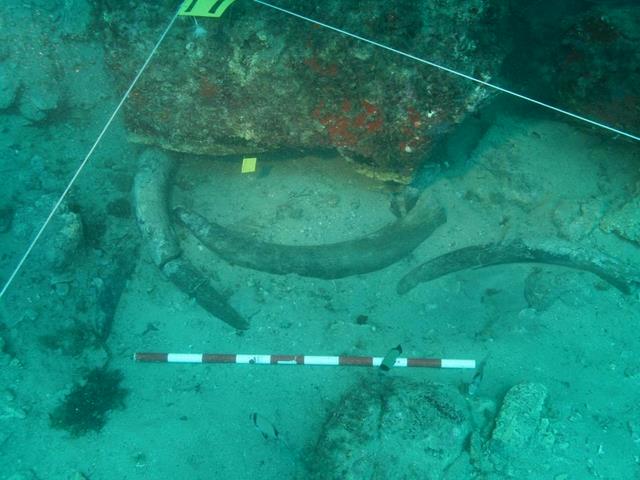
In the 1970s various exploratory excavations were carried out in the area, mapping the existence of several wrecks in the location. 13 elephant tusks were found, bearing inscriptions in the Phoenician alphabet, indicating that there was a Phoenician vessel amongst the wrecks. Some of these tusks are now on display in the ARQUA museum in Cartagena, together with other artefacts recovered including an impressive stone anchor.
In 1988 the Centro Nacional de Investigaciones Arqueologicas Submarinas identified three distinct ancient wrecks in the same location, two Roman, and one Phoenician.
The current excavations began in 2007, and it is accepted that the site was damaged by divers seeking trophies, although it is impossible to assess what may have been removed prior to the start of the current investigations.
The site is at the foot of an underwater cliff-face, near Isla Grosa, sloping down 24 metres to the seabed. Although completely submerged today, to a depth of 2 metres below the surface of the water, at the time the wrecks occurred, a quantity of rock would have been visible above the water, presenting a considerable hazard to shipping.
A fourth 18th century vessel has also now been identified.
The artefacts
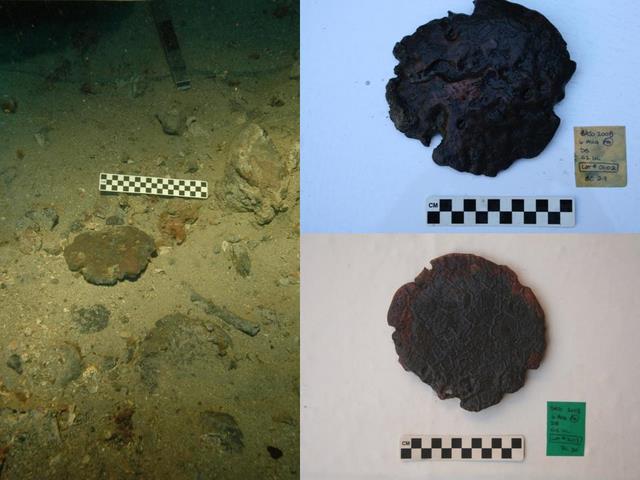 This ship appeared to be mainly transporting raw materials which would have been used for the manufacture of trade goods in other locations.
In the ancient world, several raw materials were of high economic value, hence the trouble and expense the Phoenicians went to in order to transport them on journeys which could often have taken months.
Elephant tusks
The tusks which have been recovered from this site come from a species of North African elephant which is now extinct, and would have been a smaller elephant than the Loxodonta Africana which currently inhabits northern Africa. They could have belonged to the species which famously accopmanied Hannibal on his journey from Cartagena across the Alps to Rome.
More than 15 more tusks have been recovered, after the 13 found in the 1970s. Not all are complete -some pieces are barely recognizable to the untrained eye as being ivory, but nonetheless they add to the importance of this cargo in a historical context.
Ingots of tin
More than 200 tin ingots, each weighing around a kilo, have been removed from the site. Three different formats of ingots have been recorded, and these will be analysed to try and determine their origin.
Tin was an essential component of bronze production, and was mined in the Iberian Peninsula and the Celtic nations, including Cornwall. It was forwarded on along into the Mediterranean basin for manufacturing. An overland route existed through Spain, which was known during Roman occupation as the Via de Plata, and was extended considerably during Roman occupation following an older trade route.
Ingots of Copper
Considerably fewer copper ingots, the second constituent of bronze, were also found on board
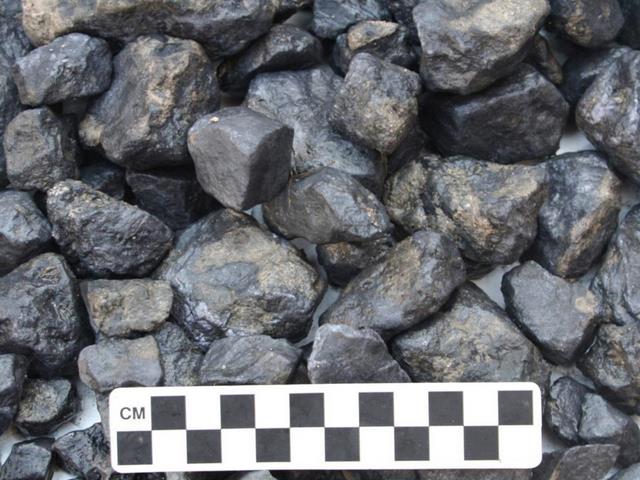 Galena -the soft greyish blue mineral form of lead sulphide.
This is one of the most abundant and widely distributed sulphide minerals, and often contains silver, as well as other minerals.
There are innumerable pieces of galena on board the vessel, and this appears to represent the main bulk of the cargo, the extraction of silver via lead being a widely-documented activity of the Phoenicians
Ceramic Materials
Ceramic material has been found on the site, representing a full cross section of items in use at the time.
An abundance of amphorae, used for transporting all types of liquids, from wine and water to fish sauce, as well as unguents and oils have been found, together with mortars, lamps, bowls and plates. Some of the amphorae even 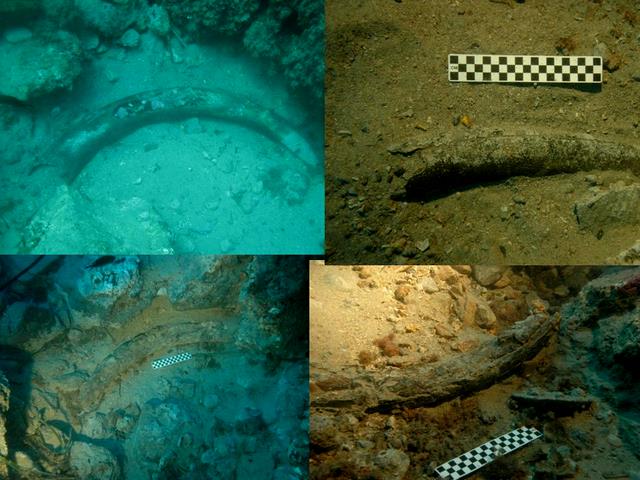 contain traces of the fish sauces they once carried and which are known to have been produced in Mazarrón and further down the coast at Águilas.
A wide variety of other objects have come to light includes pine nuts, an ingredient which still plays a valuable role in modern Mediterranean cuisine, while luxury goods have also emerged. These would have been used in trading relationships with the local elite, such as a carved stone pedestal, an ivory knife handle, and wooden combs, together with a bronze piece which appears to have formed part of a bronze bed.
Everyday items, such as tiny weights used in bartering, have also come to light, but the greatest treasure of all may still lie buried beneath the silt, tantalizing fragments of wood indicating that some of the hull may still be in situ.
Anyone wishing to trace more information about the Phoenicians in the Region of Murcia may be interested in visiting the ARQUA museum in Cartagena, which contains not only several of the pieces excavated from this site in its permanent display, but also the remains of Mazarron 1 and a reproduction of Mazarron 2.
Click to read the full history of the municipality of San Javier
Click for more information about the municipality of San Javier in SAN JAVIER TODAY
Cartagena
El Carmoli
Islas Menores and Mar de Cristal
La Manga Club
La Manga del Mar Menor
La Puebla
La Torre Golf Resort
La Union
Los Alcazares
Los Belones
Los Nietos
Los Urrutias
Mar Menor Golf Resort
Pilar de la Horadada
Playa Honda / Playa Paraiso
Portman
Roldan and Lo Ferro
San Javier
San Pedro del Pinatar
Santa Rosalia Lake and Life resort
Terrazas de la Torre Golf Resort
Torre Pacheco
Aledo
Alhama de Murcia
Bolnuevo
Camposol
Condado de Alhama
Fuente Alamo
Hacienda del Alamo Golf Resort
Lorca
Mazarron
Puerto de Mazarron
Puerto Lumbreras
Sierra Espuna
Totana
Abaran
Alcantarilla
Archena
Blanca
Corvera
El Valle Golf Resort
Hacienda Riquelme Golf Resort
Lorqui
Molina de Segura
Mosa Trajectum
Murcia City
Peraleja Golf Resort
Ricote
Sucina
Condado de Alhama
El Valle Golf Resort
Hacienda del Alamo Golf Resort
Hacienda Riquelme Golf Resort
Islas Menores and Mar de Cristal
La Manga Club
La Torre Golf Resort
Mar Menor Golf Resort
Mazarron Country Club
Mosa Trajectum
Peraleja Golf Resort
Santa Rosalia Lake and Life resort
Terrazas de la Torre Golf Resort
La Zenia
Lomas de Cabo Roig
CAMPOSOL TODAY Whats OnCartagena SpainCoronavirusCorvera Airport MurciaMurcia Gota Fria 2019Murcia property news generic threadWeekly Bulletin