


- EDITIONS:
 Spanish News Today
 Alicante Today
 Andalucia Today
A history of Cartagena, part 1: from prehistory to the Argaric culture
The first pre-human remains in Cartagena are among the earliest in Europe at 1.3 million years old
The history of Cartagena is a long and fascinating one, providing insights into the mix of cultural and racial influences over thousands of years which has resulted in the city and people we see today.
Since long before the advent of recorded history the bay in which Cartagena stands and the area inland from 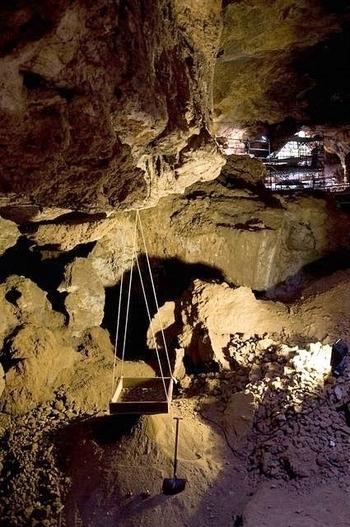 it have been home to a long series of different civilizations, all of them attracted to settle here by the coastal location, the sheltered natural harbour and natural resources which range from the bounty of the sea to the minerals of the Sierra Minera.
The safety of the bay which is now home to the port of Cartagena made it an ideal place for settlement even in pre-historic times, and at the same time those who established themselves here were also surrounded by a natural defensive structure of hills, giving lookout points over a wide area. These five hills made it relatively safe from intruders, and additional protection was given by the Sierra Minera, the Mar Menor and a natural lagoon and marshland in what is now the north of the city, on the northern side of the Paseo Alfonso XIII.
Thus the early inhabitants of what is now the city of Cartagena actually lived on a hilly peninsula, linked to the mainland only by a thin strip of land to the east, towards the area of La Unión.
Cartagena, home to the first Europeans?
The study of pre-history is hampered by the fact that by definition there is a lack of reliable records and information, but the relics discovered in settlements around the mountainous coastline make it possible to sketch an outline of pre-historical settlements in the municipality of Cartagena. The oldest human remains discovered were in the Cueva Victoria, close to Llano del Beal, and are about 1.3 million years old.
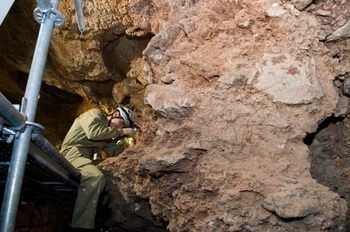 This cave is considered to be one of the most important paleontological sites in Europe, since the finds are related to the complex problem of the beginnings of Eurasian civilization. A human phalanx found in 1984 at Cueva Victoria shows that it was one of the first settlements in Europe, together with the sites at Venta Micena (Granada) and Dmanisi (Georgia), and since then more items have been found which confirm the presence of human settlements in the south-east of Spain during the lower Pleistocene era.
The findings in Granada and Cartagena have been interpreted by some as evidence that pre-historic Man first made his way to Europe by crossing the Strait of Gibraltar from Africa, rather than via the Middle East. The Cueva Victoria has been opened to the public on limited occasions over the last few years, and at the same time remains can be seen in the Cartagena Municipal Archaeological Museum.
From the Paleolithic to the Neolithic: the Neanderthals in Cartagena
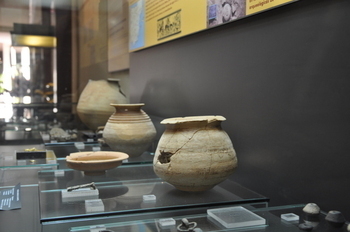
The Mousterian period covers the beginning of the last European Ice Age, from 100,000 to 35,000 years ago, and this period was primarily the age of Neanderthal Man. Archaeological findings in the Sierra Minera near Cartagena have revealed that Neanderthals hunted in the area before heading down to the coast to fish, and remnants of animals which were eaten have been found in the Cueva de los Aviones at the entry to the bay of Cartagena.
Late Paleolithic settlements were established close to the monastery of San Ginés de la Jara, an area which must have been used seasonally by hunter-gatherers at the beginning of the period. Up in the coastal mountains lies a cave known as the Cueva del Caballo ("Cave of the Horse"), where there are relics from a human occupation at the end of the Paleolithic, and it is thought that the occupants were drawn to the spot by its orientation as well as its proximity to the sea.
Also worthy of mention is the Cueva de los Mejillones in Los Belones, where harpoons and darts fashioned from bone and antlers have been found.
But it was during the Neolithic that truly permanent settlements appeared for the first time, as humans left behind them their previous hunter-gatherer existence and began to engage in agriculture, through farming and the domestication of animals. This occurred in Cartagena in the fourth millennium BC, later than in the eastern Mediterranean, and in the municipality the most important archaeological sites from the period are at the Cueva de los Pájaros in Cabo de Palos, Calblanque, the Cerro de San Joaquín in Portmán (where the foundations of some roofed dwellings can still be seen) and the early village of Las Amoladeras, at the southern end of the Mar Menor, which belongs to the Eneolithic, around 5,000 years ago.
The Argaric Culture in Cartagena
The Argaric culture existed between 2500 and 1300 BC, and is generally accepted as having spread throughout south-eastern Spain from its origins in Almería (Argar was the first major site identified as belonging to this culture, hence the name). However, 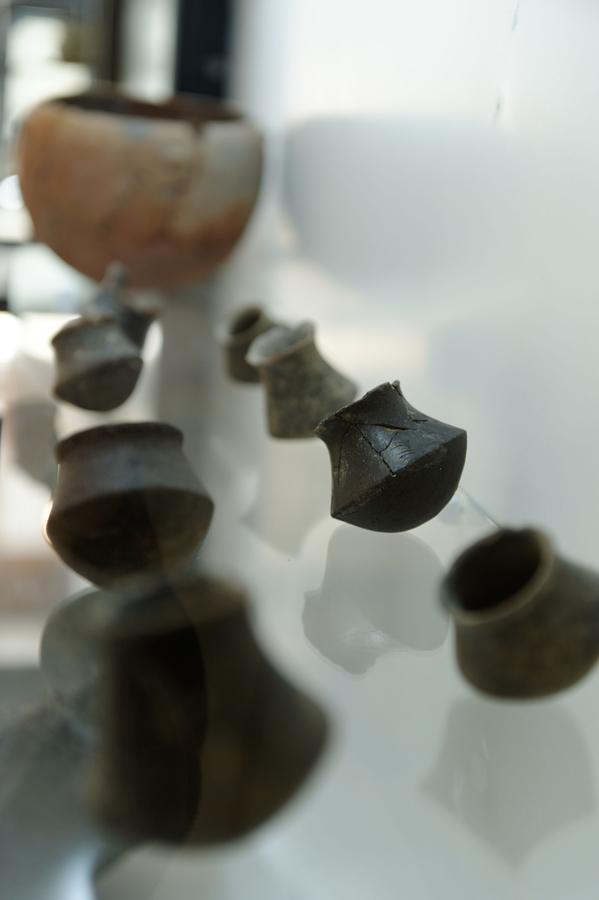 exciting discoveries at the La Bastida site in Totana are challenging this theory and the possibility exists that the culture may have arisen within the boundaries of what is now the Region of Murcia.
The Argaric was an early Bronze Age culture which had the technology to work with a number of metals, was hierarchically organized, used slaves and created sophisticated ceramics which were uniform throughout their different settlements, indicating a structure of control and conformity as well as a means of measuring.
The Argarics left few traces in Cartagena itself, although there are some remains in the surrounding countryside, probably due to the fact that the people were more interested in the mining resources which were available in the immediate environment of Cartagena than in its advantages as a port, since they did not trade much with other Mediterranean civilizations.
This led to them being attracted to the Sierra Minera, and the Late Bronze Age is represented only at the coastal site of Cala del Pino in La Manga del Mar Menor.
An excellent place to discover more about these various cultures is the Archaeological Museum in Murcia, which has a very good display going back through prehistory including some beautiful Argaric ceramics. At the same time, it’s worth mentioning the site of La Bastida in Totana, which is a working museum where visitors can see the archaeologists at work and the restoration processes undertaken on Argaric ceramics.
The story continues with following articles...
History of Cartagena part 2: Mastia, the Iberians, the Carthaginians and the Romans.
History of Cartagena part 3: from the 5th Century to 15th Century.
History of Cartagena part 4: from the Catholic Monarchs to the present day.
For more local information, news and events consult the Cartagena section of Murcia Today.
Cartagena
El Carmoli
Islas Menores and Mar de Cristal
La Manga Club
La Manga del Mar Menor
La Puebla
La Torre Golf Resort
La Union
Los Alcazares
Los Belones
Los Nietos
Los Urrutias
Mar Menor Golf Resort
Pilar de la Horadada
Playa Honda / Playa Paraiso
Portman
Roldan and Lo Ferro
San Javier
San Pedro del Pinatar
Santa Rosalia Lake and Life resort
Terrazas de la Torre Golf Resort
Torre Pacheco
Aledo
Alhama de Murcia
Bolnuevo
Camposol
Condado de Alhama
Fuente Alamo
Hacienda del Alamo Golf Resort
Lorca
Mazarron
Puerto de Mazarron
Puerto Lumbreras
Sierra Espuna
Totana
Abaran
Alcantarilla
Archena
Blanca
Corvera
El Valle Golf Resort
Hacienda Riquelme Golf Resort
Lorqui
Molina de Segura
Mosa Trajectum
Murcia City
Peraleja Golf Resort
Ricote
Sucina
Condado de Alhama
El Valle Golf Resort
Hacienda del Alamo Golf Resort
Hacienda Riquelme Golf Resort
Islas Menores and Mar de Cristal
La Manga Club
La Torre Golf Resort
Mar Menor Golf Resort
Mazarron Country Club
Mosa Trajectum
Peraleja Golf Resort
Santa Rosalia Lake and Life resort
Terrazas de la Torre Golf Resort
La Zenia
Lomas de Cabo Roig
CAMPOSOL TODAY Whats OnCartagena SpainCoronavirusCorvera Airport MurciaMurcia Gota Fria 2019Murcia property news generic threadWeekly Bulletin