







 Spanish News Today
 Alicante Today
 Andalucia Today

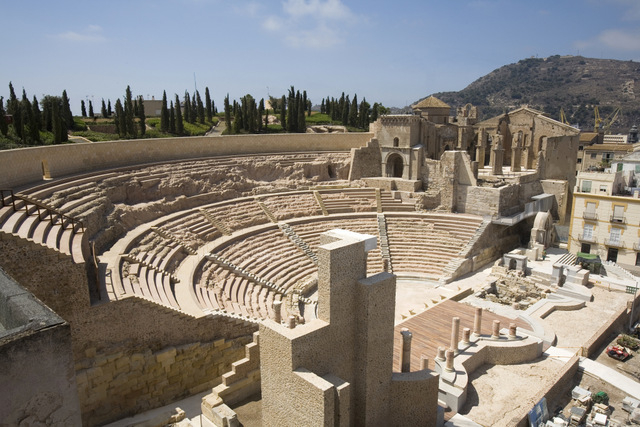 The Roman Theatre Museum is in many ways the jewel in the crown of Cartagena. It is the most visited museum in the whole of the Region of Murcia, a beautifully structured centre with the impressively restored Roman Theatre at its heart, and if you only have time to visit one historical monument in Cartagena this, for most people, would be the recommendation.
The Roman Theatre
 Almost 2,000 years had elapsed after the last spectacle was staged in the theatre by the time modern Cartagena became aware of its existence, and it had been buried beneath a series of buildings, one built over the remains of another, as Cartagena lived through Byzantine, Visigoth, Moorish and finally Christian occupations.
(Click here for more information regarding the 3,000-year history of Cartagena.)
Indications only emerged of its existence when the 19th-century Palacio de la Condesa de Peralto was demolished in 1987, the realization dawning when 3 finely carved capitals from Corinthian columns came to light that something exceptional lay buried beneath the rubble.
Following further excavation, the architect Rafael Moneo was given the job of creating the existing museum. One of the most testing conundra for Sr Moneo was that the entrance to the museum lies at sea level in the port but the theatre itself is almost at the highest point in Cartagena, built into the side of the highest of the five hills which dominated the urban landscape in Qart-Hadast, the Carthgainian city which was established in the 3rd century BC, and Carthago Nova, as the Romans renamed it after ousting their north African rivals.
The solution reached is an ingenious one: visitors pass underneath the Riquelme Palace and the Church of Santa Maria La Vieja on a series of inter-linking levels until the final step as they emerge into the dazzling light of the theatre itself is akin to the trumpeted finale of a theatrical performance, anticipation building until the star of the show is triumphantly revealed!
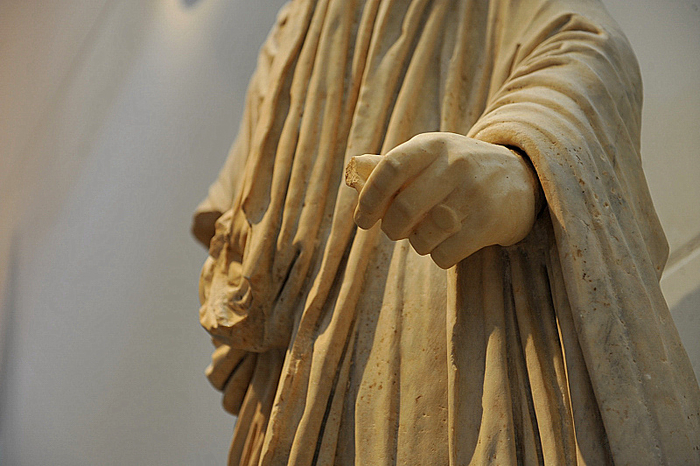
The theatre itself was built at the end of the 1st century BC, when Rome was at the height of its power under the reign of Augustus, the man who defeated Anthony and Cleopatra in battle. He was a skilled politician who understood the value of "branding" and controlled his vast Empire by creating "mini Romes" dotted around the colonies, establishing himself as a demi-god and unchallenged ruler while the rigidity of the social class structure maintained unchallenged order.
Towns were built to emulate Rome, with the phrase "all roads lead to Rome" ensuring that everyone wanted to be someone, and climbing that ladder encouraged ambition, trade, competition and social climbing. In consequence money was poured into construction projects and the wealthy patronized public works in an effort to curry favour and gain influence.
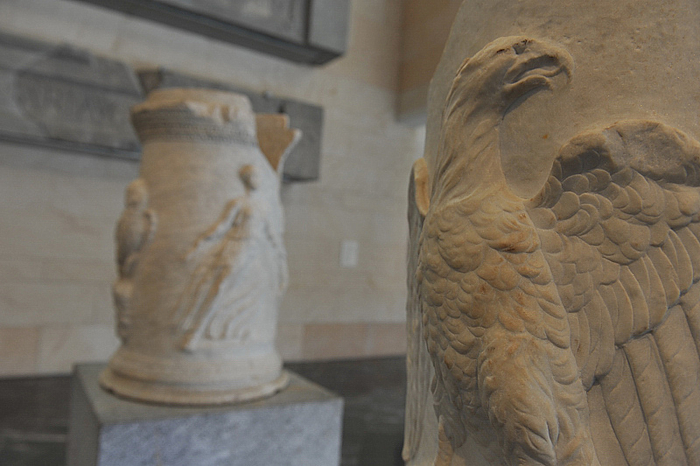
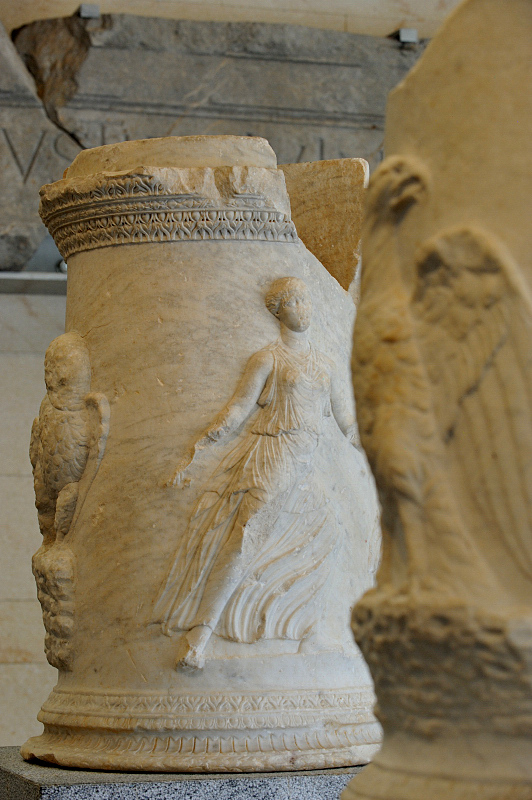
The discovery of 28 finely carved column capitals, which would have come from the workshops of the Emperor himself in Rome, testify to his patronage of this theatre, as do the presence of lintels revealing that it was also funded partly by his heirs apparent, his step-nephews Gaius and Lucius. Gaius himself was certainly present at the inauguration of the theatre in 4 BC, and this encouraged local merchants to invest even more money into the construction not only of this theatre but also of the forum, the ampitheatre and buildings of religious and social importance.
Seating 6,000 spectators, the theatre served as not only a place of entertainment, but also as a hive of propaganda and political activity, with the local elite and prestigious judges and priests reserving the most important seating and advancing their careers by the dedication of artworks and inscriptions to the glory of the Emperor: many of these artworks have been uncovered during excavations in Cartagena, but countless others remain unfound as yet or have been lost forever.
The theatre was in use for about 200 years, after which it was abandoned as Roman power waned. By the end of the 4th century a marketplace had been built on the stage area, and by 552 AD, when Cartagena was occupied by the Byzantine Empire (the eastern half of the former Roman Empire after its division in the 4th century AD), the theatre had become a series of dwellings built inside the old structure.
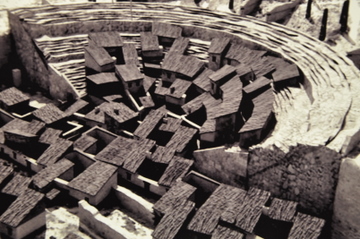
Much of the Roman stone was re-cycled and the city flourished as a busy trading port until it was invaded by the Visigoths in 625, and the buildings on the site were razed to the ground and destroyed.
The Moors conquered the area in 713 and until the 13th century the port was busy again, exporting fish products, minerals and agricultural produce. Dwellings were reconstructed over the Byzantine ruins as Cartagena became a fully-fledged trading port and ceramics from the era can be seen in some of the display cases in the museum.
In 1243 the Christians re-took what is now the Region of Murcia, and although the initial handover was fairly peaceful, rebellion 20 years later resulted in harsh fighting as the crowns of Aragón and Castile fought to put down the Moorish insurgants. Many were expelled after this uprising and in 1381 Cartagena had only 800 occupants.
By this point the theatre was totally buried under a fishermen's district, and this is how it remained until the area was cleared in the 19th century to construct the Palacio de la Condesa de Peralto.
A visit to the museum
 The museum is ingeniously designed to take visitors on a journey through time: exhibits in the showcases trace the history of the theatre while well-presented displays and audio-visuals help the visitor along on a journey of discovery, peeling back the layers through the various stages of its existence.
All of the display panels are in English as well as Spanish and there are plenty of buttons for children to press, as well as models and artefacts.
The visitor gradually climbs up through the various levels, learning something new at each one, before the finale of the theatre.
Audioguide for mobile phones
The Roman Theatre offers an audioguide service which can be downloaded via an app into mobile phones for the same price as the rental of an audioguide in the museum. The app can be downloaded prior to the visit and also revisited at a later date should the user wish to do so.
The audioguide and the app cost 2.50 euros, provide a 71-minute-long tour and are available in Spanish, English, French, Ferman and Russian.
The Roman Theatre itself
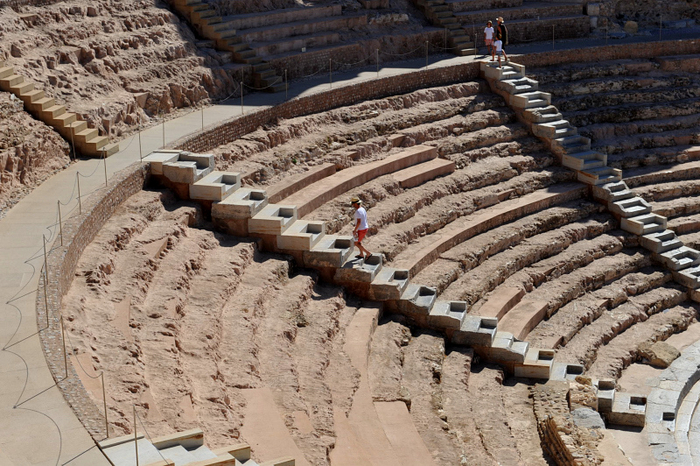
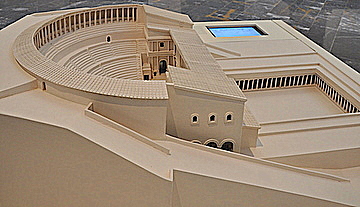
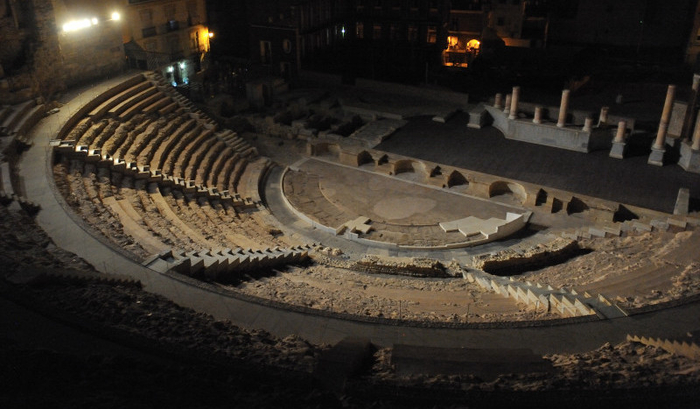
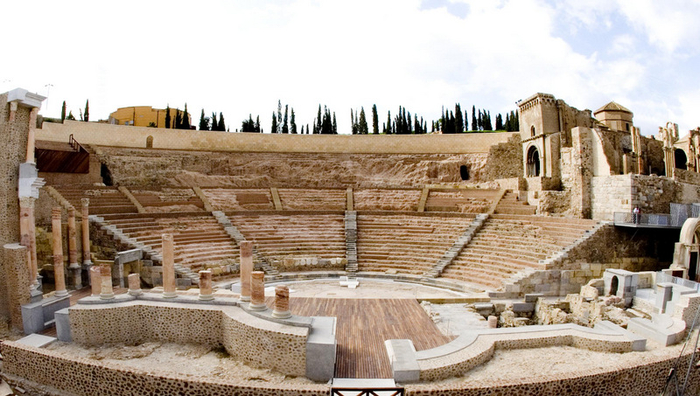
88 metres wide, in a sweeping arc with 5 radial stairs dividing the theatre into seating areas, the theatre has been reconstructed to a point at which its scale and original structure can be seen and understood.
There were 3 parts to the theatre - the seating, the orchestra pit and the stage with scenery, the latter of which was 2 storeys and 16 metres high, supported by pink columns made from marble mined in Mula in the north-west of the Region of Murcia.
Today we see only the auditorium, but the entire complex also contained large gardens and covered colonnades for protection from the sun and inclement weather, and for social gatherings. These are still concealed beneath the modern city.
Although some have criticized the reconstruction work it enables the visitor to enjoy and appreciate the remains far more than would have been possible without it, and every improvement made has been achieved through the use of specially adapted materials.
Enhanced reality goggles!
Modern technology is changing the way in which we are able to view our world and in the Roman Theatre Museum it is being used to bring the past to life!
Visitors today can either sit in the seats and imagine how vibrant the colours were, how it felt to be surrounded by fellow spectators and follow the cut and thrust of the action on the stage... or they can join a 3-D tour and experience it for themselves.
The tours follow the same basic format as a standard museum visit until participants reach the theatre itself and sit in front of the stage, donning their goggles and headsets. Simple controls set the action in motion and visitors are immersed into the past, the theatre forming around their heads and the past coming to life. It's an extraordinary experience, participants becoming totally immersed in this Roman world and understanding how it would have felt 2,000 years ago to have sat in that same seat when the power of Rome was at its zenith and the theatre lived.
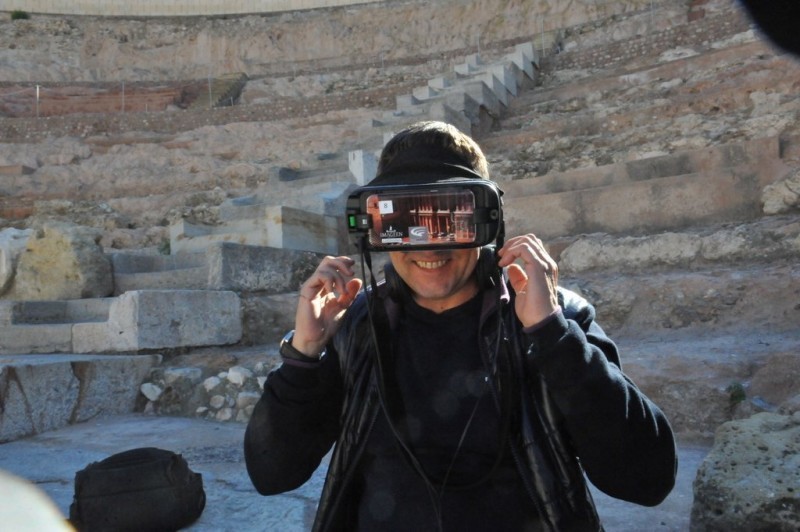
The controls of the headset are available in both English and Spanish, although at the moment the first part of the tour is only offered in Spanish. To prevent participants from attempting to wander around wearing the headsets, the goggles are only available for use in accompanied weekend tours on Saturdays and Sundays at 11.00, which must be pre-booked at a cost of 10 euros each. Groups should contact the museum management to arrange private tours.
Alternatively, the “Imageen-Cartagena” app can be downloaded onto mobile phones and tablets at a cost of just 2.50 euros.
Practicalities of a visit to the Roman theatre museum in Cartagena - Disability Access
Access
 Although the museum is on several levels, wheelchairs can cope due to the installation of ramps and lifts. The only disadvantage for those with limited mobility is that it is difficult for them to explore the actual theatre itself due to the fact of it being a stepped, split-level structure.
The installation of more than 50 markers, in the form of simple posters along the Museum's route, which are detected by an app that can be installed on a mobile phone, warn of possible obstacles or the distance to displays, as well as offering information on each room and the Cartagena Roman Theatre Museum’s most outstanding pieces.
All of this allows people with visual impairments to move completely independently throughout the Museum using the mobile app NaviLens system, which can be downloadedfree of charge from App Store and Google Play.
In addition, six of these markers have video/guide inserts in sign language, making it possible to follow the museum tour with ease. The video/guide is accessed through the mobile app NaviLens Go, which can be downloaded free of charge from App Store and Google Play.
Time to allow: for diligent readers of information and pressers of buttons, allow one to one-and-a-half hours.
Children: sensible children with a certain degree of maturity will enjoy the experience. As well as plenty of buttons to press and things to look at, the theatre itself offers lots of areas for children to explore.
The museum also runs free workshops for children, especially during the summer.
Location
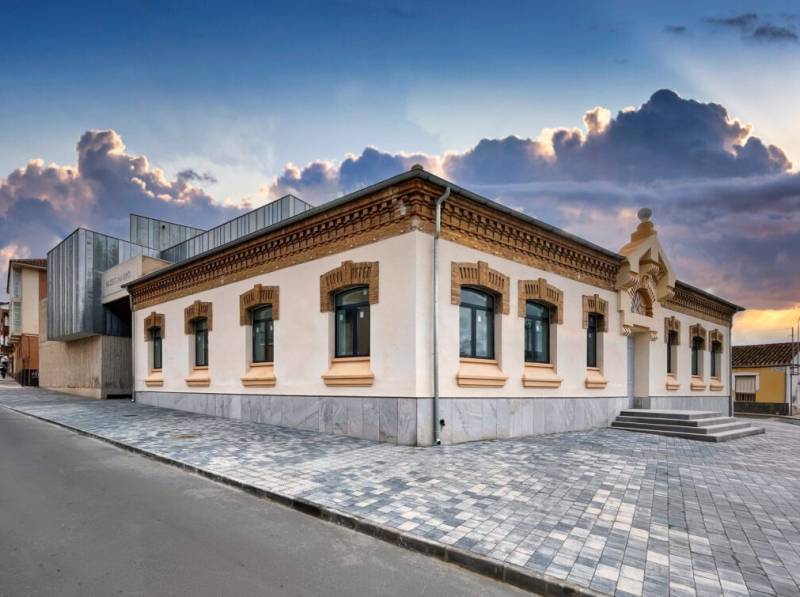
Accessed from the Plaza del Ayuntamiento, right opposite the marina on the seafront, the entrance is inside the pink and white building straight across from the impressive modernist Palacio Consistorial, the main Town Hall building.
From the cruise ship dock, walk to the main road and turn left along the front. Cross this road a the crossing installed - in theory at least, it is illegal to cross the road in Spain close to an established crossing point - and once across the road, the large stone wall protecting the city curves inwards and opens up into a Plaza. This is the Plaza del Ayuntamiento, where on the left is the Town Hall (with the Tourist Office on the corner) and opposite it is the Roman Theatre Museum.
The entrance is no more than a couple of hundred metres from where most of the cruise ships dock in Cartagena.
Contact details
Booking and further information on 968 504 802
Opening Times
1st May to 30th September (and Easter Week): Tuesday to Saturday 10.00 to 20.00, Sundays 10.00 to 14.00.
1st October to 30th April (except Easter Week): Tuesday to Saturday 10.00 to 18.00, Sundays 10.00 to 14.00.
The museum is closed on Mondays except when large numbers of cruise ship visitors are in Cartagena.
Admission fees
Standard admission 7 euros.
Reduced admission (online bookings, under 12's, pensioners, students up to the age of 25, unemployed, disabled, large families, groups of 20 or more): 6 euros.
School groups: 3 euros per head.
Children aged 3 or under are admitted free of charge.
For full information in English about the municipality of Cartagena CLICK HERE